Definition
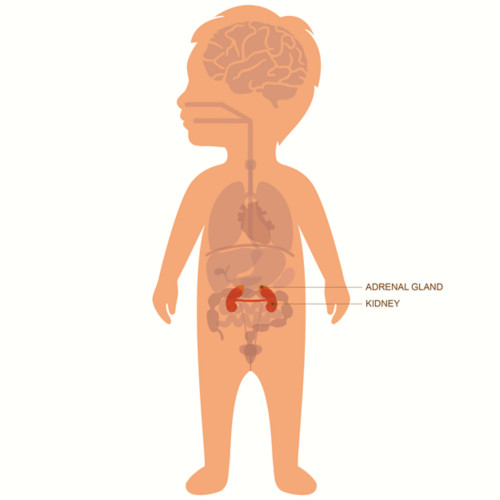
Neuroblastoma is a cancer originating from immature nerve cells called neuroblasts, found in various areas of the body. It most commonly arises in and around the adrenal glands, situated above the kidneys, with origins similar to nerve cells. However, neuroblastoma can also occur in other areas such as the abdomen, chest, neck, and spine, where groups of nerve cells are located.
This condition primarily affects infants and is less common in older children.
Causes
Cancer generally starts with genetic abnormalities causing normal cells to continue growing and not respond to growth signals. Consequently, abnormal cell accumulation forms lumps or tumors.
Neuroblastoma develops from neuroblasts, immature nerve cells formed during fetal development. Neuroblasts mature into nerve cells and cells forming the adrenal glands as the fetus develops. Most neuroblasts mature by birth, though a small number may persist in newborns. In most cases, neuroblasts mature or disappear, but in others, they form tumors namely neuroblastoma.
The exact cause of the genetic abnormalities inducing neuroblastoma remains unknown.
Risk Factor
Weight, physical activity, diet, alcohol use, and smoking are examples of lifestyle risk factors that contribute to adult cancers. Nonetheless, these factors require years to induce cancer and are not considered influential in pediatric cancers, including neuroblastoma. Environmental factors like chemical or radiation exposure during pregnancy do not increase neuroblastoma risk.
Factors that may increase neuroblastoma risk include:
- Age. More common in infants or young children.
- Family history. Children with a family history of neuroblastoma are more likely to develop it, though hereditary neuroblastoma is rare.
- Congenital abnormalities. Some studies suggest children born with defects have a higher neuroblastoma risk.
Symptoms
Neuroblastoma symptoms vary depending on the affected body part.
- Abdominal neuroblastoma, the most common type, can cause symptoms such as:
- Abdominal pain
- Painful lumps under the skin
- Changes in bowel habits including diarrhea or constipation
- Chest neuroblastoma:
- Wheezing when breathing
- Chest pain
- Eye changes like drooping eyelids and unequal pupil (black part in the middle of the eyeball) size
Other signs and symptoms may include:
- Skin lumps
- Prominent eyes
- Dark circles around the eyes
- Back pain
- Fever
- Weight loss
- Bone pain
Diagnosis
There are several examinations and procedures that can be used to diagnose neuroblastoma, namely:
- Physical examination. The doctor will perform a physical examination to look for signs of neuroblastoma.
- Urine and blood tests. These tests can indicate the cause of the symptoms and signs experienced by the child. Urine tests can be used to check for an increase in certain substances in the blood caused by the production of catecholamines (a hormone) by tumor cells.
- Radiological examinations such as X-rays, ultrasonography, CT scans, and MRI. These examinations can show the presence of lumps indicating a tumor.
- Tumor tissue biopsy. If a lump is found, the doctor may suggest taking a sample of the tumor tissue to be examined in the laboratory (biopsy). This examination can show the type of tumor cells and the specific genetic characteristics of the cancer cells. This information will be useful for doctors in planning appropriate therapy.
- Bone marrow biopsy. This examination can be done by taking a sample of bone marrow to see if neuroblastoma has spread to the bone marrow. Bone marrow itself is the inner part of the bone that produces blood cells. The sampling process is done by inserting a needle into the child's pelvic bone or spine to extract a bone marrow sample.
Once the diagnosis of neuroblastoma is established, the doctor may perform further examinations to determine the cancer stage and its spread. Knowing the cancer stage will help the doctor determine the most appropriate therapy. Radiological examinations are used to determine the cancer stage, including X-rays, bone scans, CT scans, and MRI.
Management
Doctors will choose a treatment plan based on several factors, such as the child's age, cancer stage, type of cancer cells, and the presence of accompanying chromosomal and genetic abnormalities. Doctors will use this information to categorize cancer as low, intermediate, or high risk. The therapy given will depend on this risk category.
Treatment options for neuroblastoma include:
- Surgical intervention: Surgeons may perform operations to remove cancerous cells. In children with low-risk neuroblastoma, tumor removal surgery may be the only necessary therapy. However, not all tumors can be completely excised, depending on their location and size. Tumors adhered to vital nearby organs, such as the lungs and spinal nerves, may pose too high a risk for surgery. For intermediate- and high-risk tumors, doctors will attempt to remove as much of the tumor as possible. Subsequently, additional therapies such as chemotherapy and radiation may be administered to eliminate any remaining cancer cells.
- Chemotherapy: Chemotherapy involves the use of chemicals or drugs to damage cancer cells. It targets rapidly growing cells, including cancer cells. Unfortunately, chemotherapy can also harm healthy cells that grow rapidly, such as hair follicle and digestive system cells, leading to side effects. Children with intermediate-risk neuroblastoma often undergo chemotherapy before surgery to increase the likelihood of completely removing the tumor. Meanwhile, children at high risk are usually given high-dose chemotherapy to shrink the tumor and eliminate metastasized cancer cells. Chemotherapy is typically administered before surgery and bone marrow transplantation.
- Radiation therapy: This treatment employs high-energy sources such as X-rays to destroy cancer cells. Children at low risk may receive radiation therapy if surgery and chemotherapy are ineffective. Children at high risk may undergo radiation therapy after chemotherapy and surgery to prevent relapse. Radiation therapy primarily targets the intended area, but it may also damage some healthy cells. Side effects depend on the radiation's target area and dosage.
- Bone marrow transplantation: This therapy is intended for children with high-risk neuroblastoma. It involves the use of drugs that stimulate the immune system to fight cancer cells.
Complications
Complications of neuroblastoma include:
- Cancer metastasis. Neuroblastoma can spread to other parts of the body, such as lymph nodes, bone marrow, liver, skin, and bones.
- Compression of the spinal nerves. Tumors can grow and compress spinal nerves, causing pain and weakness in limb movement.
- Symptoms due to substances produced by the tumor. Neuroblastoma cells can release certain substances that irritate normal tissues, leading to symptoms and signs known as paraneoplastic syndromes. Although rare, one of the paraneoplastic syndromes' symptoms that can occur in neuroblastoma are rapid eye movement, coordination difficulties, abdominal swelling, and diarrhea.
Prevention
The risk of cancer in adults can be reduced by lifestyle changes, such as maintaining an ideal body weight and quitting smoking. However, there are currently no specific methods to prevent cancer in children.
During pregnancy, consuming multivitamins or folic acid may reduce the risk of neuroblastoma occurrence in children, as suggested by some studies. However, further research is still needed.
If there is a family history of neuroblastoma, you can consult with a genetic counselor about the risk of your child developing neuroblastoma. However, it is important to remember that hereditary neuroblastoma is very rare.
When to See A Doctor?
You should consult a doctor if you have a risk factor with a neuroblastoma, especially if you are currently pregnant. If you or your child experience neuroblastoma symptoms as described already, you can consult and conduct further examinations at the nearest health facility.
- dr. Alvidiani Agustina Damanik
Neuroblastoma - Diagnosis and treatment - Mayo Clinic. (2022). Retrieved 16 June 2022, from https://www.mayoclinic.org/diseases-conditions/neuroblastoma/diagnosis-treatment/drc-20351022
Neuroblastoma Causes, Risk Factors, and Prevention. (2022). Retrieved 16 June 2022, from https://www.cancer.org/cancer/neuroblastoma/causes-risks-prevention.html
Mahapatra, S., & Challagundla, K. (2022). Neuroblastoma. Retrieved 16 June 2022, from https://www.ncbi.nlm.nih.gov/books/NBK448111/