
Definition
Turner syndrome is a condition that arises when the X chromosome (a sex chromosome) is either completely or partially absent. This condition occurs exclusively in females.
Causes
Typically, every individual is born with two sex chromosomes. Males receive an X chromosome from their mother and a Y chromosome from their father, while females inherit one X chromosome from each parent. In females with Turner syndrome, one copy of the X chromosome is either wholly missing, partially missing, or altered.
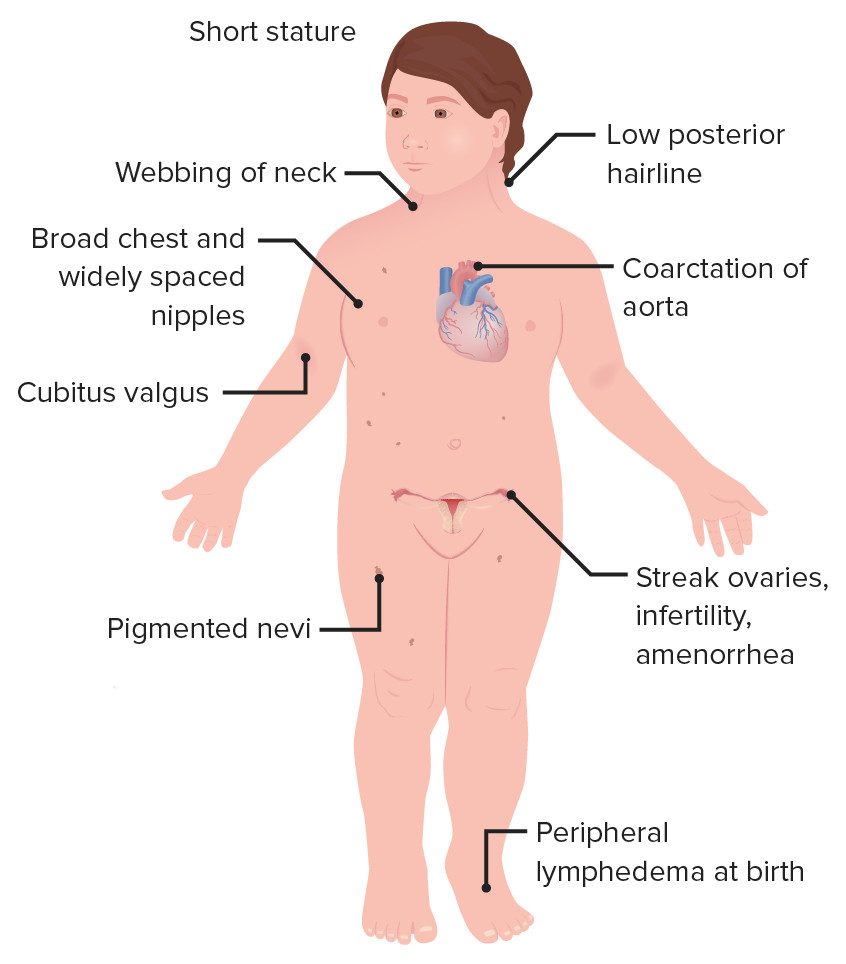
The missing or altered X chromosome in Turner syndrome causes developmental issues during fetal growth and other developmental problems post-birth, such as short stature, ovarian insufficiency, and heart abnormalities. The physical characteristics and health complications arising from this chromosomal disorder vary widely.
Risk Factor
The loss or alteration of the X chromosome occurs unpredictably. Sometimes, it results from abnormalities in the sperm or egg, though occasionally, it occurs during fetal development.
Family history does not appear to be a risk factor, meaning that parents with one child with Turner syndrome do not have a higher likelihood of having another child with the condition.
Symptoms
The signs and symptoms of Turner syndrome can vary among affected females. In some, the condition is not immediately apparent, while in others, physical characteristics may be evident from a young age.
Symptoms and signs of Turner syndrome can be categorized as follows:
- Before birth. Turner syndrome may be suspected during pregnancy through non-invasive prenatal screening, a method for detecting certain chromosomal abnormalities in the developing fetus using a blood sample from the mother. Additionally, ultrasound imaging may reveal:
- Excessive fluid accumulation at the back of the neck or other abnormal fluid accumulation (edema)
- Heart abnormalities
- Kidney abnormalities
- At birth or in infancy. Signs of Turner syndrome at birth or in infancy include:
- Broad neck
- Lower-set ears
- Wide chest with spaced nipples
- High, narrow palate
- Arms that turn outward at the elbows
- Narrow fingernails and toenails
- Swelling of the hands and feet, particularly at birth
- Slightly smaller birth length than average
- Slow growth
- Heart abnormalities
- Low hairline at the back of the head
- Smaller, lower jaw
- Short fingers and toes
- In children, adolescents, and adults. The most common signs in nearly all females, adolescents, and young women with Turner syndrome are short stature and ovarian insufficiency due to ovarian failure. Ovarian development failure can occur at birth or gradually during childhood, adolescence, or early adulthood. These signs and symptoms include:
- Slow growth
- Lack of growth acceleration for age
- Adult height shorter compared to female family members
- Failure to initiate expected sexual changes at puberty
- Early cessation of menstrual cycles not due to pregnancy
- Most females with Turner syndrome are unable to conceive without fertility treatment
Diagnosis
To diagnose Turner syndrome, a physician will conduct several assessments, including:
Medical History
The initial assessment involves a medical history interview between the doctor and the patient. Questions may include:
- Current symptoms
- Pregnancy and delivery history
- Growth and developmental history
- Medical history
- Whether any family members have similar concerns
Physical Examination
Following the medical history interview, a physical examination will be conducted. General examination includes measuring blood pressure, respiratory rate, pulse, and body temperature. For infants and children, growth and development assessments will be performed according to their age.
Additional Examinations
If signs and symptoms suggest Turner syndrome based on the medical history and physical examination, supplementary tests may be performed, including:
- Laboratory Tests
Laboratory tests are conducted to analyze the child's chromosomes. This requires a blood sample, though sometimes a buccal smear or skin sample may be requested. Chromosome analysis will determine if there is a loss or alteration of the X chromosome. - Ultrasound Imaging
Turner syndrome can be diagnosed before birth, at birth, or during early childhood. During pregnancy, certain characteristics on ultrasound may raise suspicion that the baby has Turner syndrome or another genetic condition affecting development in utero. - DNA Screening
Pregnancy screening tests that evaluate fetal DNA from maternal blood (non-invasive prenatal DNA screening or other prenatal screening) may also indicate an increased risk of Turner syndrome.
If Turner syndrome is suspected before delivery, the doctor will ask if you wish to undergo additional testing to confirm the diagnosis before the baby is born.
One of two procedures may be performed to check for Turner syndrome during pregnancy:
- Chorionic Villus Sampling. This involves taking a small sample of tissue from the placenta, which contains genetic material identical to that of the baby. Chorionic villi cells can be sent to a genetic lab for chromosomal analysis, usually performed between 11 and 14 weeks of pregnancy.
- Amniocentesis. This involves taking a sample of amniotic fluid from the uterus. The fetus sheds cells into the amniotic fluid, which can be analyzed for chromosomal abnormalities. This procedure is usually performed after 14 weeks of pregnancy.
Management
Due to the variability in symptoms and complications, treatment is tailored to address the specific issues of each individual. The primary treatment for nearly all females with Turner syndrome includes hormonal therapy, such as:
Growth Hormone Therapy
This therapy is typically administered as daily injections and is recommended to maximize height during the optimal period of childhood through early adolescence. Early initiation of this therapy can enhance height and bone growth.
Estrogen Therapy
Most females with Turner syndrome require estrogen and related hormonal therapy to initiate puberty. Estrogen therapy is often started around ages 11 to 12. Estrogen helps in initiating breast development and increasing uterine volume. It aids in bone mineralization and, when combined with growth hormone, can also assist in height enhancement. Estrogen therapy is usually continued for life until the average age of menopause is reached.
Complications
Due to the variability in symptoms and complications, treatment is tailored to address the specific issues of each individual. The primary treatment for nearly all females with Turner syndrome includes hormonal therapy, such as:
Growth Hormone Therapy
This therapy is typically administered as daily injections and is recommended to maximize height during the optimal period of childhood through early adolescence. Early initiation of this therapy can enhance height and bone growth.
Estrogen Therapy
Most females with Turner syndrome require estrogen and related hormonal therapy to initiate puberty. Estrogen therapy is often started around ages 11 to 12. Estrogen helps in initiating breast development and increasing uterine volume. It aids in bone mineralization and, when combined with growth hormone, can also assist in height enhancement. Estrogen therapy is usually continued for life until the average age of menopause is reached.
Read more about hypertension in pregnancy here: Hypertension In Pregnancy - Definition, Cause, Symptoms, And Treatment
Prevention
Turner syndrome cannot be prevented, as it is a congenital condition. Parents cannot take measures to prevent the chromosomal error leading to the loss of the X chromosome.
When to See a Doctor?
It can sometimes be challenging to distinguish the signs and symptoms of Turner syndrome from other conditions. Prompt, accurate diagnosis and appropriate care are essential. Consult a doctor if you have concerns about the possibility of Turner syndrome.
Looking for more information about other diseases? Click here!
- dr. Alvidiani Agustina Damanik
Turner syndrome (2022) Mayo Clinic. Mayo Foundation for Medical Education and Research. Available at: https://www.mayoclinic.org/diseases-conditions/turner-syndrome/symptoms-causes/syc-20360782 (Accessed: November 16, 2022).
Turner Syndrome: Medlineplus Genetics (no date) MedlinePlus. U.S. National Library of Medicine. Available at: https://medlineplus.gov/genetics/condition/turner-syndrome/ (Accessed: November 16, 2022).
Turner syndrome: Causes, symptoms, diagnosis & treatment (2021) Cleveland Clinic. Available at: https://my.clevelandclinic.org/health/diseases/15200-turner-syndrome#prevention (Accessed: November 16, 2022).