
Definition
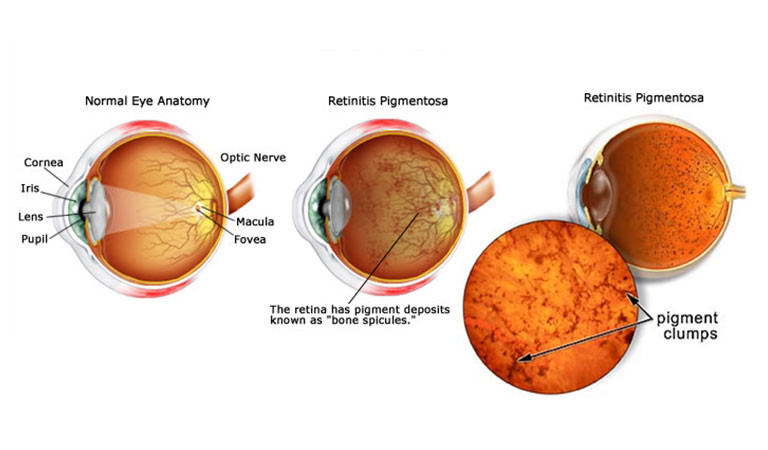
Retinitis pigmentosa (RP) refers to a group of genetic disorders characterized by the damage and death of photoreceptor cells in the retina, which are responsible for light sensitivity and are situated at the back of the eye. This rare condition affects approximately one in 4,000 individuals both in the United States and globally. Research in South Asia indicates that more than half of the genes in the South Asian population, particularly in Pakistan and India, are associated with this disease.
Causes
Retinitis Pigmentosa (RP) is a genetically inherited disease that results in the damage or malfunction of photoreceptor cells. Most RP cases arise from mutations in the rhodopsin gene. The age of onset, the progression rate of symptoms, and the degree of visual function loss are influenced by the pattern of gene inheritance within each family. RP leads to damage to photoreceptor cells, specifically affecting the rod and cone cells in the retina. Rod cells, located in the outer layer of the retina, are responsible for vision in low-light conditions, while cone cells enable the perception of detailed images in bright light. A total of 90 genes have been identified as potential causes of RP.
Risk Factor
Any condition causing long-term inflammation of the nasal passages or sinuses, such as infections or allergies, can increase the risks of developing nasal polyps.
Symptoms
In the initial stages of RP, rod cells are typically the first to be damaged, leading to symptoms such as a narrowing of the visual field, resulting in tunnel vision. Other symptoms may include myopia or nearsightedness. Some patients may retain normal visual acuity. The progression rate of symptoms varies among individuals, and the age of onset differs for each person. Many individuals experience blindness by the age of 40 due to RP. Ophthalmologists assess anatomical changes in the retina and the progression of damage using an ophthalmoscope.
Diagnosis
Retinitis pigmentosa diagnosis is confirmed by a physician using ophthalmoscopy, which allows examination of the eye's fundus or back. The ophthalmoscope can visualize the retina, choroid, optic nerve center, and blood vessels. Ophthalmoscopic examination reveals dark spots indicative of pigment deposits in the retina. Additional tests for RP diagnosis include:
- Electroretinogram (ERG): This test measures the electrical activity in retinal cells and is sensitive in detecting RP.
- Visual Field Examination: This test evaluates the extent of photoreceptor cell damage within the visual field. It can be performed using a confrontation test or a perimetry tool. The confrontation test compares the patient's visual field with the doctor's, while the perimetry examination involves the patient pressing a button upon seeing a red light.
- Genetic Testing: This is conducted on some individuals to identify genetic mutations, providing insight into the hereditary pattern of RP in the family.
- Tests for Other Diseases: Conditions resembling RP, such as syphilis, are ruled out through blood tests.
Management
The management of RP involves early detection and consistent monitoring of symptom progression. Currently, there is no definitive therapy to halt or cure RP.
- Annual examinations are advised to identify complications that may impair vision and to assess disease progression.
- In the case of RP-related complications such as cataracts, cataract surgery can enhance visual function.
- Avoiding smoking is crucial, as smoking can accelerate the progression of RP compared to non-smokers.
- The use of glasses that block sunlight up to 550 nanometers, including side shields, is recommended.
- Vitamin A supplementation and other medications should be taken as per a doctor’s advice.
- Certain medications, such as oral acetazolamide and topical carbonic anhydrase inhibitors, can alleviate RP symptoms.
- While some medications like calcium antagonists show potential benefits, their efficacy and safety are not fully established.
- Retinotoxic medications should be avoided or used with caution in RP patients. These include drugs for erectile dysfunction, isotretinoin, and other retinoids. Neurotoxic drugs should also be used under strict medical supervision.
Complications
Complications in RP patients may include cataracts, glaucoma, keratoconus, and posterior vitreous detachment (PVD).
- Cataract: A condition where the lens becomes increasingly opaque, leading to blurred vision. In RP patients, cataracts are caused by the inflammatory process of RP, with posterior subcapsular cataracts being the most common type.
- Glaucoma: A disorder associated with increased eye pressure, linked to pigment migration in the eye, which impedes fluid movement.
- Posterior Vitreous Detachment (PVD): Fluid accumulation from retinal layer detachment can tear the retina, resulting in visual function loss.
Prevention
Currently, there is no known method to prevent RP development due to its genetic origins. Regular examinations are crucial for early detection of retinopathy pigmentosa symptoms.
When to See a Doctor?
Seek medical attention immediately if you experience the following symptoms:
- Worsening vision at night or in poorly lit environments.
- Impaired vision in bright environments.
- Loss of peripheral vision or tunnel vision.
- Difficulty judging depth of surface, such as when walking on curbs or climbing stairs.
Looking for more information about other diseases? Click here!
- dr Ayu Munawaroh, MKK
What Is Retinitis Pigmentosa?. American Academy of Ophthalmology. (2021).
Zafar, S., Ahmed, K., Ali, A., & Baig, R. (2017). Retinitis pigmentosa genes implicated in South Asian populations: a systematic review. Journal of the Pakistan Medical Association, 67(11), 1734.
Retinitis Pigmentosa | UVA Health [Internet]. Uvahealth.com. 2021
Encyclopedia M. Ophthalmoscopy: MedlinePlus Medical Encyclopedia [Internet]. Medlineplus.gov. 2021
Encyclopedia, M., & pigmentosa, R. (2021). Retinitis pigmentosa: MedlinePlus Medical Encyclopedia. Medlineplus.gov.
Kanski, J. J. (2020). Clinical diagnosis in ophthalmology. Philadelphia: Elsevier.
Smoking. Retina UK. (2021).
Glaucoma - Symptoms and causes. Mayo Clinic. (2021).
Rhegmatogenous Retinal Detachment (RRD): Background, Pathophysiology, Epidemiology. Emedicine.medscape.com. (2021).