Definition
Craniofacial microsomia (CFM) is a congenital condition where part of the face develops abnormally. The term "microsomia" refers to a body part being smaller than usual, while "craniofacial" refers to the skull (cranium) and face (facial).
This condition primarily affects the jaw and ears but can also involve the face, cheeks, and neck bones, potentially interfering with functions such as breathing, eating, and hearing. In rare cases, craniofacial microsomia can involve abnormalities in other body systems, including the heart, kidneys, ribs, and spine. It is the second most common facial abnormality after cleft lip.
It is estimated that craniofacial microsomia occurs in about 1 in 3,000 to 5,000 births. In some cases, it can cause the underdevelopment of the structures that form the roof of the mouth during fetal development. Treatment for this condition is complex and requires a multidisciplinary approach involving pediatricians, eye specialists, ENT specialists, plastic surgeons, oral surgeons, physiotherapists, and psychologists.
Causes
The exact cause of craniofacial microsomia is still not well understood. In some cases, it is believed that the condition arises from a mutation or alteration in a specific gene that affects the development of the child’s face.
Individuals with craniofacial microsomia have a 2-3% chance of passing the condition on to their children. However, most cases are sporadic, with no clear genetic link, meaning they are not inherited from parents who have the same condition.
Risk Factor
Several factors may increase the risk of craniofacial microsomia, including:
-
A family history of craniofacial microsomia.
-
Exposure to teratogenic substances during pregnancy, which are substances that can cause birth defects, such as thalidomide.
-
The use of facial products containing retinoic acid during pregnancy.
-
Multiple pregnancies, such as twin pregnancies.
-
Bleeding during the second trimester of pregnancy.
-
Diabetes during pregnancy, including gestational diabetes or pre-existing diabetes mellitus.
-
Smoking and alcohol consumption during pregnancy.
Symptoms
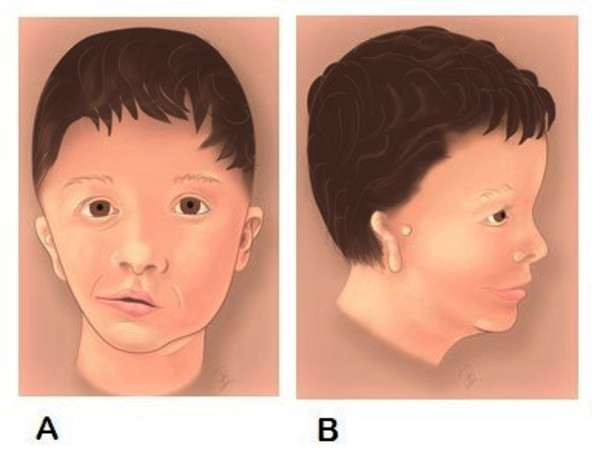
The symptoms of craniofacial microsomia can vary significantly depending on the severity of the condition and how much the face is affected. Children with mild forms may have a smaller jaw and may develop skin lumps or warts near the ears, which may appear normal.
In more severe cases, one side of the child’s face may appear smaller than the other, often accompanied by abnormal ear shapes or even the absence of ears. This condition can result in difficulties with chewing, breathing, hearing, or speaking.
The specific symptoms depend on which part of the face is affected, including:
- In the ear:
-
Small ears (microtia) or absent ears (anotia).
-
Absence of the ear canal (aural atresia).
-
Hearing difficulties.
-
- In the face:
-
Asymmetry, where one side of the face appears different from the other.
-
Facial palsy or paralysis, making it difficult to move facial muscles.
-
Small cheekbones.
-
A wide mouth due to a gap at the corner (macrostomia).
-
Cleft lip or palate.
-
Skin bumps in front of the ear or on the face.
-
Pinkish-white tissue growth on the eye (epibulbar dermoid).
-
Small and abnormally shaped eyes (microphthalmia).
-
- In the jaw and teeth:
-
Limited mouth opening (trismus).
-
Shortened lower jaw.
-
Crooked lower jaw.
-
Teeth misalignment or malocclusion (when teeth do not close properly).
-
- In the respiratory system:
- Breathing difficulty.
Diagnosis
To diagnose craniofacial microsomia, the doctor will conduct a medical interview, physical examination, and supporting tests.
Medical Interview
During the medical interview, the doctor will ask about the following:
-
Current symptoms.
-
The mother’s pregnancy and childbirth history.
-
The child’s growth and developmental history.
-
Any treatments the child has received.
-
Whether any family members have experienced similar issues.
Physical Examination
The doctor will then perform a physical examination. If the patient is pregnant, the doctor will check the mother’s general condition, including blood pressure, body temperature, breathing rate, and pulse. If the patient is a baby or child, the doctor will conduct a thorough head-to-toe examination and assess any signs and symptoms of craniofacial microsomia.
Diagnostic Tests
The doctor may also recommend supporting tests. For pregnant women, an ultrasound during routine pregnancy check-ups may help detect fetal abnormalities. For infants, the following tests may be performed:
-
MRI: To provide a more detailed view of bone tissue.
-
CT Scan: To assess the muscles and bones in greater detail.
-
Echocardiogram: To check for any heart-related issues.
-
Kidney ultrasound (USG): To evaluate kidney health.
-
Spinal X-ray: To examine the positioning of the spine.
Management
Various treatments are available for craniofacial microsomia, with surgery being the primary option. Surgical procedures can be performed on affected areas, such as the face or jaw, to help reconstruct the upper and lower jaws. In cases of facial asymmetry, surgery can also be used to correct these imbalances.
If the patient has a cleft lip, surgery can be performed to reconstruct the lip. If there are misaligned teeth that affect the jaw’s appearance or function, removal of these teeth may be necessary.
For patients born without eyes, surgery can be performed to create a socket for an artificial eye. Additionally, surgeries may be needed to reposition the eyelids. In cases involving the ear, nose, and throat, procedures to reconstruct the ear canal and earlobe can help improve functionality.
Other treatments may include tube feeding therapy if the child is unable to eat by mouth. Additionally, the use of braces, hearing aids, and speech therapy can support the treatment and aid in the child’s development.
Complications
If left untreated, craniofacial microsomia can lead to various complications that significantly affect the child's quality of life. These may include respiratory issues, hearing or vision problems, difficulties with eating, and speech problems. These challenges can negatively impact the child’s self-confidence and may cause emotional stress.
Prevention
Currently, there is no specific way to prevent craniofacial microsomia. However, the most effective preventive measure is to avoid exposure to teratogenic substances during pregnancy, such as those found in facial products containing retinoic acid or the drug thalidomide.
Regular prenatal check-ups are essential to help detect any fetal abnormalities early. While craniofacial microsomia is not typically life-threatening, it can affect a child's quality of life and make daily activities more difficult.
When to See a Doctor?
Craniofacial microsomia should be evaluated immediately if a baby is born with asymmetrical or abnormal facial features, especially if the child is experiencing difficulties with eating or failing to gain weight appropriately.
Looking for more information about other diseases? Click here!
- dr Hanifa Rahma
Birgfeld CB., Heike C., (2012). Craniofacial Microsomia. Retrieved 16 November 2022, from https://www.ncbi.nlm.nih.gov/pmc/articles/PMC3424699/
Children's Hospital of Philadelphia - Hemifacial Microsomia. (2021). Retrieved 16 November 2022, from https://www.chop.edu/conditions-diseases/hemifacial-microsomia
Cleveland Clinic - Hemifacial Microsomia. (2022). Retrieved 16 November 2022, from https://my.clevelandclinic.org/health/diseases/22810-hemifacial-microsomia
Xu X., et al., (2021). Novel risk factors for craniofacial microsomia and assessment for their utility in clinic diagnosis. Retrieved 16 November 2022, from https://academic.oup.com/hmg/article/30/11/1045/6145950