Definition
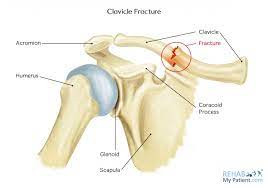
A clavicle fracture refers to a break in the collarbone, which is one of the major bones in the body. The clavicle lies between the sternum (breastbone) and the shoulder blade, playing a crucial role in connecting the arm to the torso.
The clavicle is positioned over several vital nerves and blood vessels, but these structures are usually not harmed when the bone fractures.
Clavicle fractures are common and make up around 5% of all fractures in adults. The majority of these fractures occur in the middle or shaft of the clavicle. Less frequently, fractures happen near where the clavicle connects to the sternum or shoulder blade.
The severity of a clavicle fracture varies. It may involve only a slight crack in the bone, or it may break into multiple pieces (comminuted fracture). Sometimes, the bone remains aligned but may shift out of place (displaced fracture).
Causes
Clavicle fractures are most often caused by a direct blow to the shoulder, which can occur during a fall onto the shoulder or in an accident, such as a car crash. A fall onto an outstretched arm can also result in a clavicle fracture.
In infants, clavicle fractures may happen during delivery as the baby passes through the birth canal.
Risk Factor
Clavicle fractures are more common in individuals who participate in contact sports such as soccer, wrestling, rugby, and hockey. These fractures are also prevalent in activities with a higher risk of falls, including cycling, skiing, snowboarding, and skateboarding. As a result, athletes are at a greater risk for this type of injury.
In addition, individuals over the age of 55 face an increased risk of clavicle fractures due to a higher likelihood of falling as they age.
Symptoms
Clavicle fractures are often very painful and can make it difficult to move the arm. Other common symptoms include:
-
The shoulder protruding downward and forward
-
Inability to lift the arm due to pain
-
A throbbing sensation when trying to raise the arm
-
A visible deformity or lump in the collarbone area
-
Bruising, swelling, and tenderness around the clavicle
Diagnosis
To diagnose a clavicle fracture, your doctor will perform a physical examination and may order imaging tests.
Physical Examination
The doctor will inquire about how the injury occurred and your symptoms. Afterward, the shoulder area will be carefully examined.
With a clavicle fracture, you’ll often notice a visible deformity or lump at the site of the fracture. Applying gentle pressure to the area typically causes pain. Though the bone fragments rarely break through the skin, they can push against the surface, creating a noticeable lump.
In addition to examining the fracture, the doctor will perform tests to ensure that no nerves or blood vessels have been damaged during the injury.
Radiological Examination
An X-ray is commonly used to view dense structures like bones. Your doctor will recommend an X-ray to help locate the fracture and evaluate its severity. In some cases, an X-ray of the entire shoulder may be performed to identify any additional injuries.
Management
If the broken ends of the clavicle remain aligned and do not protrude through the skin, surgery is typically not needed. Many clavicle fractures heal naturally without the need for surgical intervention.
Non-surgical Treatment:
- Arm Brace
- An arm sling is often used to provide immediate comfort following the injury. It helps keep the arm and shoulder in place as the bone heals.
- Medications
- Pain relievers, such as paracetamol, can be used to manage pain while the fracture heals.
- Physical Therapy
- Although some pain may be present, it’s crucial to maintain the arm’s mobility to prevent stiffness in the shoulder and elbow. Patients are often encouraged to begin elbow range-of-motion exercises shortly after the injury.
After a clavicle fracture, it is normal to experience some loss of strength in the shoulder and arm. As the bone heals, pain will reduce, and your doctor will introduce gentle shoulder exercises to aid recovery.
These exercises are essential for preventing muscle stiffness and weakness. More strenuous exercises will be introduced gradually once the fracture has fully healed.
Regular doctor visits are necessary to monitor the healing process. During these check-ups, your doctor will use X-rays to track the bone’s healing progress. Once healing is complete, you will be able to gradually resume normal activities.
In some cases, the clavicle may protrude from its normal position before the fracture has fully healed. It’s important to keep follow-up appointments with your doctor to ensure that the bone remains properly aligned.
Surgical Treatment
If the fracture causes a significant misalignment of the bone, surgery may be recommended. The goal of surgery is to realign the fracture and ensure it remains in place until it heals, improving shoulder strength during the recovery process.
The most common surgical procedures for clavicle fractures are open reduction and internal fixation. During these procedures, the fracture is repositioned (reduced) to its normal alignment, and special metal devices are used to hold the bone in place.
After surgery, some pain is expected as part of the healing process. Most people manage this with ice and over-the-counter pain relievers. If the pain is more severe, your doctor may prescribe stronger medication.
Specific exercises are necessary to restore shoulder movement and strength. Your doctor will either provide a home therapy plan or refer you to a physical therapist.
The therapy program will usually begin with light range-of-motion exercises, and muscle-strengthening exercises will be gradually added as healing progresses. While recovery may be slow, following your physical therapy plan is vital to return to normal activities.
Complications
A nonunion occurs when a fracture does not heal properly. In some cases of nonunion, the patient may experience only mild pain and retain good arm movement, meaning no further treatment is needed.
However, in other instances, a nonunion can result in significant pain, requiring additional treatment or surgery.
A malunion occurs if the fracture heals in an abnormal position, causing misalignment. Surgical intervention for malunion is rare and depends on the degree of misalignment and the impact on arm movement.
There are risks associated with surgery, including:
-
Infection
-
Bleeding
-
Impaired wound healing
-
Pain
-
Blood clots
-
Blood vessel or nerve damage
-
Reaction to anesthesia
-
Impaired bone healing
-
Lung injury
-
Numbness or tingling below the clavicle
-
Surgical instrument irritation
Individuals who smoke, have diabetes, or are elderly are at a higher risk for complications both during surgery and during the recovery process. These groups are also more likely to encounter problems with wound healing and the bone fracture itself.
Prevention
Clavicle fractures tend to occur suddenly, and while it’s difficult to fully prevent them, you can take steps to minimize the risk of injury:
-
Always drive safely and wear your seatbelt while in a vehicle.
-
Maintain a balanced diet.
-
Ensure you’re getting enough calcium to strengthen bones.
-
Use proper technique and maintain good posture during sports or physical activities.
-
Wear protective gear when participating in activities or sports that carry a risk of clavicle fractures.
When to See a Doctor?
If you suspect you have a collarbone injury and experience symptoms of a fracture, go to the nearest emergency room immediately. While waiting to see the doctor, you can stabilize your arm using a cloth sling. Avoid moving your arm to prevent further injury.
Pain relievers such as paracetamol or ibuprofen can help alleviate pain, but avoid giving aspirin to children under 16.
Applying an ice pack to the injured area can help reduce swelling and discomfort. However, ensure the ice is wrapped in a cloth to avoid direct skin contact, which can cause skin burns.
Looking for more information about other diseases? Click here!
- dr Hanifa Rahma
Clavicle fracture (broken collarbone) - orthoinfo - aaos (2022) OrthoInfo. Available at: https://orthoinfo.aaos.org/en/diseases--conditions/clavicle-fracture-broken-collarbone/ (Accessed: November 22, 2022).
(2020) NHS choices. NHS. Available at: https://www.nhs.uk/conditions/broken-collarbone/ (Accessed: November 22, 2022).
Clavicular fracture (no date) Physiopedia. Available at: https://www.physio-pedia.com/Clavicular_Fracture (Accessed: November 22, 2022).
Dubowy, S.M. (ed.) (2018) Broken collarbone (clavicle fracture) (for teens) - nemours kidshealth, KidsHealth. The Nemours Foundation. Available at: https://kidshealth.org/en/teens/clavicle-fracture.html (Accessed: November 22, 2022).
Broken collarbone (clavicle fracture): Symptoms, treatment, healing (2020) Cleveland Clinic. Available at: https://my.clevelandclinic.org/health/diseases/16874-broken-collarbone-clavicle-fracture (Accessed: November 22, 2022)