Definition
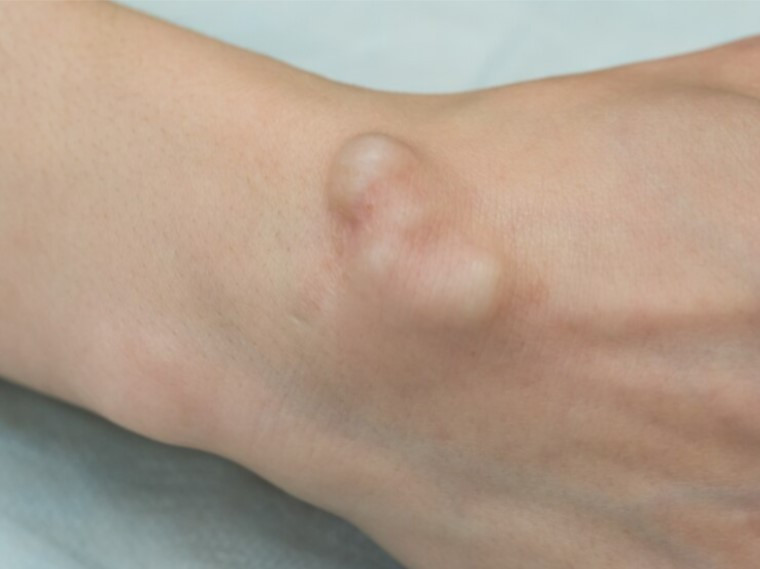
A ganglion cyst is a fluid-filled bump that forms under the skin, usually near joints or the tissue connecting muscles to bones (tendons). These cysts are commonly found on the wrists or ankles.
Typically, ganglion cysts are round or oval in shape and contain a jelly-like fluid. They can range in size from small, around the size of a peanut, to larger cysts, which can reach up to 2.5 cm in diameter.
While ganglion cysts are usually benign and do not cause symptoms, they can sometimes be painful and interfere with the movement of joints. The cyst may become painful if it grows near nerves, and the location of the cyst can limit joint movement.
If a ganglion cyst is affecting your daily activities, your doctor might suggest draining the fluid using a needle. Surgery to remove the cyst may also be an option, but if there are no symptoms, treatment may not be necessary. In some cases, a ganglion cyst may disappear on its own.
Ganglion cysts typically develop in specific joints or tendons. Frequent use or movement of the area can cause the cyst to swell and increase discomfort. Common locations for ganglion cysts include:
-
Wrists, on the front or back
-
Fingers, near the finger joints (either near the palm or beneath the fingernail)
-
Feet, near the knee or big toe
Causes
The exact cause of ganglion cysts is not well understood. Some theories suggest that they can form when a tendon is injured, causing the surrounding skin to leak. Current research indicates that ganglion cysts are likely caused by repeated small injuries. These injuries may trigger the production of hyaluronic acid, which accumulates and creates the jelly-like fluid inside the cysts.
Risk Factor
Several factors can increase the likelihood of developing ganglion cysts, including:
-
Gender: Women are at a higher risk, with the condition occurring up to three times more frequently than in men.
-
Age: Ganglion cysts typically appear between the ages of 20 and 50.
-
History of injury: Joint injuries, such as tendonitis (from tendon overuse), may contribute to the formation of ganglion cysts, although research is still inconclusive on this.
-
Arthritis: Inflammation of the joints can increase the risk of ganglion cysts. Those with arthritis often develop cysts near their fingers, particularly around the nail area.
Symptoms
The primary symptom of a ganglion cyst is the presence of a lump beneath the skin. The symptoms associated with a ganglion cyst include:
-
Location of the lump: Ganglion cysts typically form in the tendons or joints of the hands, feet, wrists, or ankles.
-
Shape and size: These lumps are usually round or oval and less than 2.5 cm in diameter. The cyst can grow larger over time or with increased activity in the surrounding area.
-
Pain: Although ganglion cysts are typically painless, they may cause discomfort if they press on a nerve. In such cases, the pressure can lead to pain, tingling, numbness, or even muscle weakness.
If you experience troubling symptoms such as muscle pain or tingling sensations, it’s advisable to consult a doctor. These issues could be caused by the pressure exerted by the lump, which can lead to inflammation and discomfort.
Diagnosis
Physical Examination
Doctors typically diagnose ganglion cysts through a physical examination. The size, shape, and location of the lump (commonly on the wrist or finger) are key indicators of a ganglion cyst. The doctor may press on the lump to assess whether it causes discomfort.
Additionally, the doctor will shine a light through the lump to check if it is translucent (slightly see-through). In some instances, the doctor may perform a biopsy by taking a sample from the lump for further analysis. Ganglion cysts usually contain jelly-like fluid and are not solid.
Radiological Examination
In rare cases, the doctor may recommend radiological exams, such as an X-ray, to investigate the cause of the lump. An ultrasound might also be used to distinguish between a solid lump and a ganglion cyst.
This type of examination can also help differentiate a ganglion cyst from a synovial cyst. In cases of small ganglion cysts, the swelling may not be visible, but pain can still be present. This is known as an occult ganglion cyst.
Management
Ganglion cysts often resolve on their own without the need for treatment. If the cyst does not cause pain or discomfort, treatment is generally unnecessary. Your doctor may suggest:
-
Avoiding repetitive hand and wrist movements.
-
Using a wrist brace, as limiting movement (immobilization) can help the cyst shrink.
-
Wearing footwear that avoids direct pressure on the cyst if it appears on the foot or ankle.
If the cyst causes pain or restricts movement, your doctor may recommend draining the fluid from the cyst. If the pain continues, anti-inflammatory medications may be prescribed to reduce swelling and relieve discomfort.
Surgery is another option if other treatments fail. It is important to avoid traditional, ineffective treatments, such as striking the lump with a heavy object, which may cause the cyst to rupture and lead to further injury and pain.
Complications
Complications from ganglion cysts can occur, particularly if the cyst presses on a nerve, leading to impaired joint movement. These complications may include tingling sensations, muscle weakness, and numbness. Additionally, a ganglion cyst that interferes with daily activities can reduce mobility.
Post-treatment complications might include:
-
Infection of the surgical wound
-
Scar tissue formation at the surgical site
-
Nerve damage
-
Blood vessel injury
Prevention
There is no known way to prevent ganglion cysts, as their exact cause remains unclear. If a ganglion cyst recurs, consult your doctor to discuss possible treatments or removal options.
When to See a Doctor?
You should see a doctor if you notice a lump on your wrist, palm, or ankle. If the ganglion cyst is interfering with your daily activities, it is important to discuss appropriate treatment options with your doctor.
Looking for more information about other diseases? Click here!
- dr Anita Larasati Priyono
Ganglion Cyst. (2020). Retrieved 07 November 2022, from https://www.mayoclinic.org/diseases-conditions/ganglion-cyst/symptoms-causes/syc-20351156
Ganglion Cyst. (2022). Retrieved 07 November 2022, from https://www.nhs.uk/conditions/ganglion/
Ganglion Cyst. (2022). Retrieved 07 November 2022, from https://www.ncbi.nlm.nih.gov/books/NBK470168/
Ganglion Cysts. (2020). Retrieved 07 November 2022, from https://my.clevelandclinic.org/health/diseases/15554-ganglion-cysts
Ganglion Cysts. (2022). Retrieved 07 November 2022, from https://www.healthline.com/health/ganglion-cysts
Ganglion Cyst. (2020). Retrieved 07 November 2022, from https://www.healthdirect.gov.au/ganglion-cyst