Definition
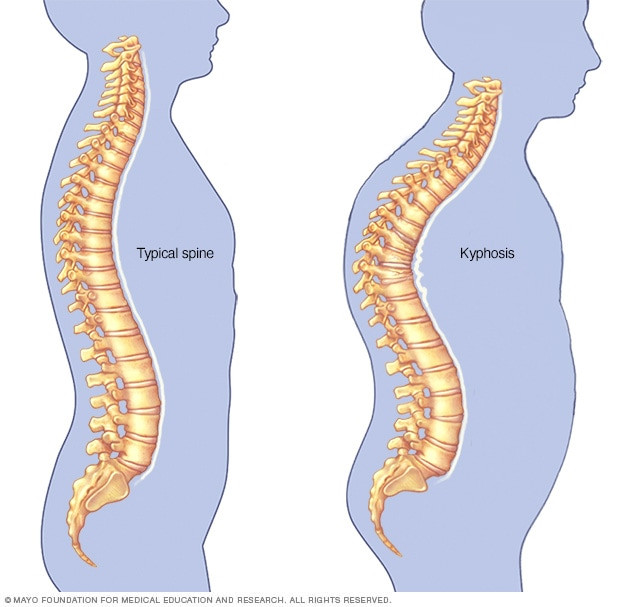
Kyphosis refers to an excessive outward curve of the spine, resulting in a noticeable hunching of the upper back. While it is normal for the spine to have a slight curve, particularly in the upper back (ranging from 20 to 45 degrees), kyphosis occurs when the curvature exceeds 50 degrees, causing the back to appear hunched.
Mild kyphosis generally doesn’t cause significant issues, but in severe cases, it can lead to pain and even difficulty breathing.
Causes
The spine, which runs from the base of the skull to the hips, is made up of vertebrae separated by soft discs that absorb shock. In kyphosis, the upper spine or thoracic region curves excessively.
Although the spine has a natural curve to accommodate the chest cavity (which houses vital organs such as the heart and lungs), a curvature greater than 50 degrees is considered abnormal.
Several factors can contribute to kyphosis, including:
- Poor Posture (Postural Kyphosis)
This is the most common form of kyphosis, typically appearing during adolescence. Poor posture, such as slouching, leaning backward in a chair, or carrying heavy loads, can put strain on the muscles and ligaments of the spine, exacerbating the curvature.
- Scheuermann’s Kyphosis
This condition occurs when the spine does not develop normally. The spine's shape differs from the typical alignment, making it more susceptible to curvature. Scheuermann’s kyphosis generally begins before puberty, and its cause remains unclear. This form of kyphosis is more common in males.
- Congenital Kyphosis
Congenital kyphosis results from spinal development abnormalities that occur during pregnancy. It often involves the fusion of two or more vertebrae, leading to kyphosis from birth.
- Other Medical Conditions
Kyphosis can also be caused by spinal injuries, such as fractures, or by conditions that weaken the spine, like osteoporosis or calcification, making it more prone to curvature.
In children, kyphosis may be linked to medical conditions such as:
-
-
Spina bifida: A congenital birth defect that prevents the neural tube from developing properly.
-
Osteogenesis imperfecta: A genetic bone disorder that causes bones to break easily.
-
Ehlers-Danlos syndrome: A group of connective tissue disorders that affect the skin, blood vessels, bones, and other tissues.
-
Risk Factor
Several factors can increase the likelihood of developing kyphosis, including:
-
The curvature of the spine typically increases with age.
-
Kyphosis is more common in women than men.
-
Low bone density raises the risk of spinal fractures and curvature.
-
Poor posture can also contribute to the development of kyphosis.
Symptoms
Kyphosis may not cause any symptoms aside from an unusually curved or hunched back. However, in some instances, kyphosis can result in:
-
Back pain and stiffness.
-
A noticeable difference in the height or alignment of the shoulders or shoulder blades.
-
The head appears to tilt forward in comparison to the body.
-
Fatigue.
In more severe cases of kyphosis, symptoms may worsen over time, and the individual might experience difficulty breathing or eating.
Diagnosis
Kyphosis is typically diagnosed through a physical examination where the doctor observes your posture and the curvature of your spine from different angles. They will examine you while you stand, bend, and lie down. They will also check for any balance issues and assess your range of motion.
For children, it is important to provide the doctor with information about the mother’s pregnancy and the child’s birth history. Since some types of kyphosis are linked to neurological disorders, if the child has developmental delays, the doctor may recommend further evaluations.
Additional diagnostic tests may include:
- Imaging Examinations
X-rays are commonly used to determine the degree of curvature and to detect any deformities in the spine. If more detailed imaging is required, a CT scan may be performed. MRIs, which use radio waves and strong magnetic fields, can identify infections or tumors in the spine.
- Neurological Examination
If numbness or muscle weakness is present, a neurological examination may be necessary to check the transmission of nerve impulses between the spinal cord and limbs.
Management
Treatment for kyphosis depends on the severity of the curvature, the symptoms, the underlying cause, and the patient’s age. Mild, asymptomatic kyphosis generally does not need treatment.
Over-the-counter medications like paracetamol or ibuprofen can be used to manage pain. If the patient has osteoporosis, medications to improve bone density may be prescribed. In addition to medications, stretching and muscle-strengthening exercises can help enhance spinal flexibility and alleviate back pain.
For children, non-surgical methods, such as wearing a brace, may be recommended to prevent the kyphosis from worsening as the child grows.
Surgical treatment is rarely needed but may be required in cases where the curvature compresses nerves or spinal cord branches. Surgery can correct this condition in such severe cases.
Complications
Most complications of kyphosis occur only in severe instances. Persistent pain and a significant curvature can interfere with breathing as the spine presses against the lungs and airways.
In some cases, compression or pinching of the nerves running through the spine can cause symptoms like:
-
Numbness or tingling in the arms and legs.
-
Balance problems.
-
Loss of normal bladder or bowel control.
These complications require immediate medical attention. Older children may feel self-conscious about their appearance due to kyphosis or the need to wear a brace. This can impact their self-esteem, and some children may withdraw socially, becoming reluctant to participate in activities such as sports.
Prevention
Kyphosis caused by poor posture can be prevented by encouraging your child to:
-
Avoid slouching and maintain an upright posture while sitting.
-
Avoid carrying heavy school bags; if using a backpack, ensure it is well-designed to evenly distribute the weight.
-
Regular exercise to strengthen back muscles and maintain flexibility. Activities like swimming, running, walking, and yoga are particularly beneficial in preventing back problems.
When to See a Doctor?
Seek medical advice if you notice an increasing curvature in your child’s spine or your own back.
Looking for more information about other diseases? Click here!
- dr Hanifa Rahma
Kyphosis. (2022). Retrieved 19 August 2022, from https://www.nhs.uk/conditions/kyphosis/.
Kyphosis - Diagnosis and treatment - Mayo Clinic. (2022). Retrieved 19 August 2022, from https://www.mayoclinic.org/diseases-conditions/kyphosis/diagnosis-treatment/drc-20374209.
Kyphosis. Retrieved 19 August 2022, from https://www.hopkinsmedicine.org/health/conditions-and-diseases/kyphosis.