
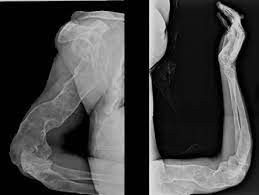
Definition
Fibrous dysplasia is a benign growth of fibrous tissue that replaces normal bone. Fibrous tissue is not as strong as bone. Generally, fibrous tissue forms to replace damaged tissue, similar to scar tissue (which appears after an injury). Fibrous dysplasia is a rare condition, accounting for only 7% of all benign bone tumors.
As the fibrous tissue grows and expands, one or more of the following may occur:
- Bone deformity
- Fragile bones
- Pain
- Uneven bone growth
Types of Fibrous Dysplasia
Fibrous dysplasia is generally divided into two types:
- Monostotic fibrous dysplasia, only one bone is affected. This is the most common form of fibrous dysplasia.
- Polyostotic fibrous dysplasia, more than one bone is involved. This can affect multiple bones in the same limb or several bones throughout the body. This type is usually more severe than the monostotic form and is often detected at a younger age.
Fibrous dysplasia is a chronic, long-term condition that often worsens over time. Although the growth of fibrous tissue may stabilize and stop, it will not disappear. In polyostotic types and in growing children, the disease may progress or worsen more quickly.
Fibrous dysplasia can also occur as part of a broader disorder. For example, McCune-Albright syndrome is characterized by polyostotic fibrous dysplasia, accompanied by hormonal imbalances, early puberty, and patches of discolored skin known as café-au-lait spots.
If you want to know more about café au lait spots, you can read about them here: Café-au-lait - Understanding, Cause, Symptoms, Treatment.
Causes
The exact cause of fibrous dysplasia is unknown. However, it is believed that the condition is caused by a chemical defect in a specific bone protein. This defect may result from a genetic mutation that occurs before birth, though the condition is not hereditary or caused by diet or environmental factors.
This genetic mutation causes bone cells to produce an abnormal type of bone, called fibrous bone. While this abnormal bone begins forming before birth, it often remains undetected until childhood, adolescence, or even adulthood.
Risk Factor
Anyone can develop fibrous dysplasia, and it can be diagnosed at any age. However, it is typically diagnosed in children between the ages of 3 and 15. Sometimes, it is not diagnosed until adulthood. The condition is not associated with gender, ethnicity, or geographic location.
Symptoms
Symptoms of fibrous dysplasia vary between individuals, but common symptoms include:
- Limping or an unsteady gait
- Bone deformities, particularly in individuals with repeated fractures. Poor healing of these fractures may lead to visible bone deformities, especially if they affect the facial bones or cause limb bones to curve.
- Bone pain, especially as fibrous tissue grows and weakens the bone. Pain is more likely when weight-bearing bones such as the thigh, shin, or pelvis are involved. The pain typically begins as a dull ache, worsens with activity, and improves with rest. Over time, the pain may increase.
- Bone fractures, as fibrous bone is much weaker than normal bone, making it more prone to breaks. These fractures can occur suddenly without prior symptoms or after a period of dull pain.
- Scoliosis, or curvature of the spine.
Any bone in the body can develop fibrous tissue. Multiple bones can be affected at the same time, often on one side of the body. However, fibrous dysplasia does not spread from one bone to another.
Commonly Affected Bones
The bones most often affected by fibrous dysplasia include:
- Facial bones
- Pelvic bones
- Rib bones
- Shinbone (tibia)
- Skull bones
- Thighbone (femur)
- Upper arm bone (humerus)
- Spine
Some people with fibrous dysplasia experience few or no symptoms. When this occurs, fibrous dysplasia is discovered coincidentally during an X-ray or other test performed to assess an injury or unrelated medical condition.
In other cases, multiple bones are affected, making the condition more severe. In these cases, surgery is required to remove the affected bone and avoid or correct fractures or deformities.
Fibrous dysplasia symptoms may be similar to those of other medical conditions. Always consult your doctor for a definitive diagnosis.
Diagnosis
In addition to a medical history review and physical examination, further tests may include:
- Biopsy. A sample of tissue is taken and examined under a microscope to check for cancer cells or other abnormalities. This procedure can also be used to remove abnormal tissue from affected bones.
- Bone scan. Your doctor may perform a bone radiography exam to check for other abnormalities throughout your bones. During this exam, a very small amount of radioactive contrast material will be injected into your body through a vein.
- Laboratory tests. Blood and urine tests may show elevated levels of certain enzymes and amino acids when fibrous dysplasia is actively growing.
- Radiology tests. MRI or CT scans may be done for a more detailed evaluation of affected bones.
- X-ray. This test provides images of bones and tissues.
Management
Specific treatment for fibrous dysplasia is determined by factors such as:
- Age, overall health, and medical history
- Severity of the disease
- Tolerance for medications, procedures, or therapies
- Expectations for the disease’s progression
- Patient preference
If surgery is needed, procedures may include:
- Placement of rods along long bones
- Removal of affected bone, followed by bone grafting
Other treatments include:
- Medications
- Pain relief
- Physical therapy
Complications
Potential complications of fibrous dysplasia include:
- Severe facial deformities may cause vision or hearing problems.
- If leg or pelvic bones are involved, walking difficulties or inflammation in nearby joints may occur.
- In rare cases, the same abnormalities seen in bone cells can affect glandular cells, leading to hormonal issues. This is more likely in severe polyostotic cases.
- Very rarely (less than 1% of cases), fibrous dysplasia may become cancerous, especially in polyostotic forms or McCune-Albright syndrome.
Prevention
There is no known way to prevent fibrous dysplasia, as it is caused by a genetic mutation with an unknown origin.
When to See a Doctor?
If you notice signs or symptoms of fibrous dysplasia, contact your doctor for further evaluation.
Looking for more information about other diseases? Click here!
- dr Anita Larasati Priyono
Fibrous dysplasia (2019) Fibrous Dysplasia | Johns Hopkins Medicine. Available at: https://www.hopkinsmedicine.org/health/conditions-and-diseases/fibrous-dysplasia
Fibrous dysplasia - orthoinfo - aaos (no date) OrthoInfo. Available at: https://orthoinfo.aaos.org/en/diseases--conditions/fibrous-dysplasia
Fibrous dysplasia (FD): Symptoms, diagnosis, treatment & outlook (2018) Cleveland Clinic. Available at: https://my.clevelandclinic.org/health/diseases/17902-fibrous-dysplasia