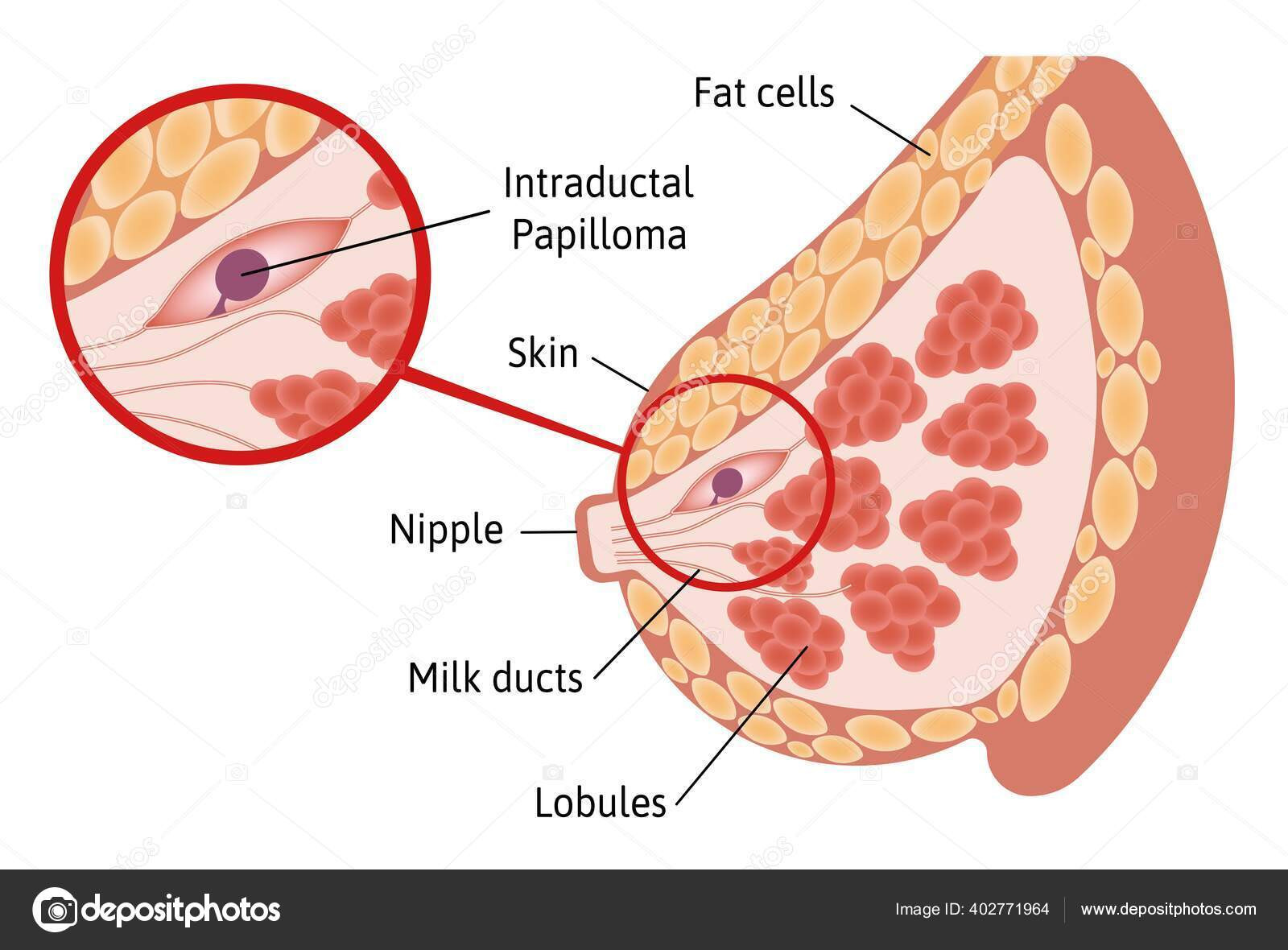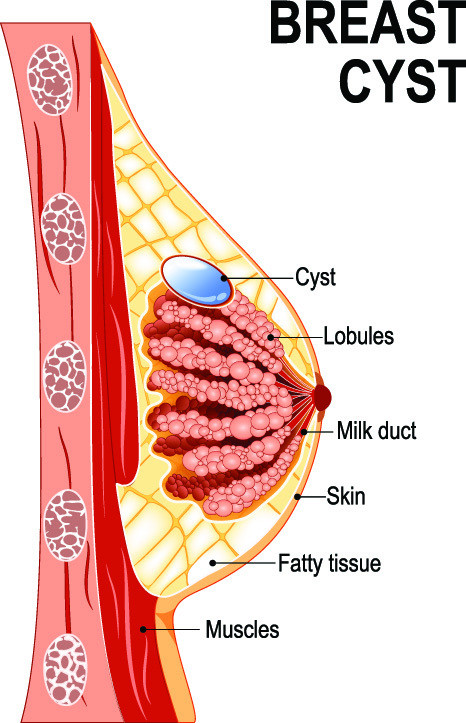

Definition
Galactocele, also known as lactocele or milk cyst, is a benign lump filled with breast milk. The term galactocele originates from the Greek words “galatea,” meaning milk white, and “-cele,” meaning pouch. This lump occurs in breastfeeding women or up to several months after a woman stops breastfeeding. Galactoceles are relatively rare. They can occur in one or both breasts, are round in shape, and are usually painless.
Although galactocele can occur around the milk ducts in the breast, it most often appears in the area around the areola. The areola is the dark-colored part of the breast surrounding the nipple. It is important to distinguish galactocele from other breast conditions such as cysts, benign tumors, abscesses, or breast cancer, as the treatments differ.
Causes
Galactocele is generally caused by the obstruction of the breast milk. In the breast, some glands and ducts function to produce and transport milk during breastfeeding. Galactocele occurs when there is an obstruction in these ducts. This obstruction forms a pouch, making it appear as a lump.
Galactocele can occur during breastfeeding, although it is more commonly found after the period of breastfeeding ends, when milk starts to stagnate in the breast.
The causes of blocked milk ducts can include:
- Breast injury
- Breast inflammation
- Nipple abnormalities
- Rarely, tumors
- Poor attachment between mother and baby
- Incomplete emptying of the breast
- Poor breastfeeding position
Risk Factor
Factors that can increase the risk of galactocele include:
- Women who are breastfeeding or who have stopped breastfeeding within the last few months
- First-time mothers
- Infrequent breastfeeding or breastfeeding combined with formula feeding
- Consumption of contraceptive pills
- Difficulties during breastfeeding, such as:
- Baby with a cleft lip
- Baby with congenital abnormalities in the esophagus or digestive tract
- Mother with HIV or Ebola infection
- Mother undergoing treatment with radioactive drugs harmful to the baby
- Earlier weaning
- Previous use of anti-nausea medications such as metoclopramide and domperidone
Symptoms
Galactocele rarely causes complaints and is often discovered incidentally. The lump is usually painless, soft, and easily movable and can grow larger. Its size is typically comparable to a kiwi fruit or a golf ball. Galactocele can persist for several weeks or longer. Additionally, the lump may be accompanied by the discharge of milk-like fluid from the nipple.
Diagnosis
A general practitioner, lactation consultant, or gynecologist can diagnose galactocele. The doctor will conduct a medical interview to gather more detailed information. Physical examination and additional tests may be performed if necessary.
Medical Interview
The doctor will typically ask about:
- The complaints experienced and their duration
- Pregnancy and childbirth history
- Breastfeeding habits and any problems encountered during breastfeeding
- Previous medical history
- Family medical history
- Previous treatments
- Daily activities
Physical Examination
The physical examination starts by checking vital signs such as blood pressure, temperature, pulse, and respiratory rate. The doctor then performs a local examination of the patient’s breasts, comparing both breasts for changes in size, color, skin consistency, and nipple condition. The lump is inspected and palpated to determine if it is benign or possibly malignant.
Additional Tests
Further tests can be conducted to confirm the cause of the lump. Recommended tests for diagnosing galactocele include ultrasound or aspiration biopsy.
Ultrasound is ideal for assisting in the diagnosis. Aspiration involves extracting fluid from the breast using a fine needle, which can also be a treatment.
Mammography is rarely indicated and should only be performed under certain conditions. In some cases, if there is suspicion of another type of breast lump, the doctor may recommend a biopsy, taking a tissue sample from the breast for microscopic examination.
Management
Galactocele usually resolves independently after hormonal changes during pregnancy and breastfeeding return to normal. However, treatment depends on the condition and severity of the galactocele.
For breastfeeding mothers, warm compresses on the lump can help reduce breast swelling. You can also improve your breastfeeding position and ensure a proper latch between the baby’s mouth and your nipple. Massage the breast to help milk flow.
If you experience pain, your doctor may prescribe pain relievers. Typically, the doctor will perform aspiration using a fine needle to remove the blocked milk. Antibiotics may be given to prevent infection. Discuss all treatment options with your doctor.
Complications
Complications from galactocele include:
- Difficulty breastfeeding the baby
- Infection and inflammation in the breast
- Baby's weight loss due to inadequate milk production
- Severe cases may cause maternal stress due to inability to meet breastfeeding needs
Prevention
Prevention can be achieved by effectively emptying the breast during breastfeeding. Using a breast pump can be an alternative to emptying the breast. Learning about proper latch techniques can also reduce the risk of blocked milk ducts.
A self-examination of the breast, known as BSE (Breast Self-Examination), can be performed monthly to check for any lumps. Here are the steps for BSE:
- Stand straight in front of a mirror. Identify any changes in the shape and surface of the breasts, swelling or lumps, or changes in the nipple.
- Raise both arms. Bend the elbows and place hands behind the head. Push elbows forward and observe your breasts. Push elbows back and repeat the observation.
- Place hands on hips. Lean forward to hang the breasts. Push elbows forward and tighten the chest muscles.
- Raise one arm at a time. First, raise the left arm and bend the elbow. Use the fingertips of your right hand to feel and press the breast, using up-and-down or circular movements. Repeat on the right breast.
- Squeeze both nipples. Look for any abnormal fluid discharge.
- Lie down with a pillow under your right shoulder. Raise your arm and observe the right breast. Feel the breast with circular or up-and-down movements. Use fingertips to press all parts of the breast, including the armpit area. Repeat for the left breast.
When to See a Doctor?
See a doctor if the lump does not disappear after home treatment for a few days. Make an appointment with your doctor if the area around the lump turns red or the lump increases in size.
Looking for more information about other diseases? Click here!
- dr. Alvidiani Agustina Damanik
Gada PB., Bakshi G., (2022). Galactocele. Retrieved 10 October 2022, from https://www.ncbi.nlm.nih.gov/books/NBK578180/#!po=4.16667.
Kementrian Kesehatan Republik Indonesia - Enam Langkah SADARI untuk Deteksi Dini Kanker Payudara. (2016). Retrieved 10 October 2022, from http://p2ptm.kemkes.go.id/tag/enam-langkah-sadari-untuk-deteksi-dini-kanker-payudara.
Medscape - Diagnosing and Managing Breast Disease during Pregnancy and Lactation. (1997). Retrieved 10 October 2022, from https://www.medscape.com/viewarticle/719249_4.
Winkler JM., (1964). Galactocele of the Breast. Retrieved 10 October 2022, from https://www.americanjournalofsurgery.com/article/0002-9610(64)90352-6/pdf#relatedArticles.